Showing posts with label Reviews. Show all posts

Saturday, May 23, 2009

Glee!

Keeping up with my tradition of reviewing the obscure, I will now go ahead and talk about something that has the potential of either fading into obscurity or becoming the next best thing television has seen in a while. I kind of knew that the pilot was going to be awesome when I watched this trailer before the show premiered, and was quite excited about it.


Before I start gushing, I must confess two facts that can be potentially used against me in the future. But, my last post was on the Gmail Fox and I think I have kind of lost all my sense of shame after that. So, I shall go right ahead and confess:
  1. I love musicals. No, I unironically love them all. I even liked the movie version of Rent. This is how shameful my love for musicals is.
  2. I also love Journey, you know the band, Journey. What can I say? It all stems from my teenage love for power ballads. I promise to get over these songs one day, but I suspect that day is not going to come very soon.
The pilot of this show has somehow miraculously ended up involving both the points listed above, and there was no just no way that I was going to end up not liking this show after that. The show is a kind of mash up between Bring It On meets Election meets Mean Girls meets High School Musical meets Fame. Considering how amazing each of these films are, the show has not only a lot to live up to, but also a big possibility of becoming into some of the other not-very-good high school films that are out there, and believe me there plenty of those around.

The American high-school move genre is a very precarious one to invest into because 95% of the films it generates are simply awful. However, if well made, and mind you decent movies in this genre are extremely rare, the films have a potential of becoming into something special. There is a very thin line between the high-school films that are good and the ones that are not. Of course, you are going to make fun of me because I watch high-school films, but I do, and I love the good ones. I mean, how can you not? They are not just chick flicks; I like to look at them as a plethora of wit that give us a deep insight into American popular culture. Regardless for my blind love for this genre, I have to admit that the bad ones are simply painful to sit through. However much I would like to continue and point out the differences between gems like Clueless and the awful ones like The Prince and Me, I am well aware that I am digressing from the initial subject of my conversation.

Glee is not a high-school film. No, it is much more than that. It is a high school television show, which makes it pretty unique from everything else that is out there. What I mean by unique is that the show does well in trying to distance itself from other high school dramas that are currently airing like Gossip Girl or 90210. Plus it markets itself as a musical comedy, and not one of those musicals where people talking suddenly burst out into song and dance routines, but a musical where the music numbers actually make sense and are limited.

The premise of the show is pretty simple, it revolves around a teacher who is trying to train a bunch of high school misfits to participate in a national competition, which involves singing and dancing. To top it off, there are evil blond cheerleaders, evil dim-witted football players, rival schools and a whole set of quirky teachers (who are fit for everything else apart from teaching) involved in trying to make the lives of these six teenagers as hard as possible. All the want to do is perform on stage, dammit! Why should this be so hard?

Since it has the pretty conventional high-school plot, the show will probably have to do a lot in the future to make sure it remains quirky and witty, which is going to be hard. They also have a lot of expectations to live up to in terms of the music, epsecially after the amazing rendition of Rehab performed by a rival school and Don't Stop Believing that were used in the pilot. All this gushing aside, the pilot was not perfect. Few high school films are perfect, and I have yet to watch a high school show that is perfect. There were a few parts that made you go meh along with the traditional stereotypes of high school characters complete with thin, blond cheerleaders and a fat African American girl who wants to be Beyoncé.

The pilot was just a preview and the show is going to start airing later this year in September/October. I thought the pilot was pretty decent, and good enough to make me continue watching it for a while, but pilots rarely tell you all there is to know about a tv show. If the epic failure of Kings (which I thought started out as quite well, by the way) is to be taken as an indication, all we know is that audiences are fickle and unpredictable. I loved Glee, but I love Journey and watch all my television shows online, so my demographics and opinions don't really count in the big scheme of things.

PS: The lead actress has an amazing voice and I love her character so hard. She puts gold stars next to her name every time she signs it somewhere. How could you possibly not love this girl?

Thursday, March 05, 2009

Jai Ho!


When half my city was taken over by terrorists, there was not a single person who asked about what was happening or if I was doing okay, but now that Slumdog Millionaire has won a whole load of Oscars, I have random people asking me about Bombay at least once a day for the past week.

I don't want you to get me wrong, regardless of what I feel about the film, I totally wanted it to win in every category it was nominated for at Oscars. Its a weird Indian solidarity thing that we are just born with. And yes, I do know that its not actually an Indian film, but who really cares about these small details? Plus, I cannot think of anyone in the Indian film industry apart from A.R.Rahman (I love it how every person who reads the nominations out in award shows is unable to pronounce his name right. If you are called out to read the nominations of a certain award category, the least you can do is take some effort to get the names right!) who deserves this kind of recognition. The funny thing is that his soundtrack for this film isn't even one of his best works and yet, incredibly it seems to be getting crazy recognition.

All this said, I actually liked the film. I do think that it is overrated and the second half of the film was quite weak due to the inability of the two lead characters to act. This is really sad because I love Dev Patel and Freida Pinto. They're adorable in interviews, and Dev's next role is going to be as my favourite character in my favourite television series of all time, and I can't help but be ridiculously excited about this. In any case, my pleasure while viewing the film was muchly diminished because I kept getting distracted by Dev's fake Indian accent and Freida's pretty smiley face.

The first half of the film is fabulous. Its very Danny Boyle, and kind of reminded me of Trainspotting, which is an awesome film (I'm not not just saying this because Ewan McGregor has a naked scene in it!). As a side note, I'd like to say that I really do love all the Danny Boyle films that I've watched. Sunshine was amazing, and I don't care if I'm the only human being who liked it. I thought that it was really well made. Also, I know The Beach was awful, but I was going through a post-Titanic, Leonardo Di Caprio phase at that time and have fond memories of that movie. But I digress as usual, coming back to what I was saying, the first part of Slumdog Millionaire is really good. The child actors are brilliant, the colours, the imagery, the music, and the story have a great flow, and I can see why exactly the film was considered Oscar worthy. Then suddenly something happens, and I don't quite know what.

Actually I do know what happens, the kids grow up, the lead kid grows up into an awkward Dev Patel, who has this blank expression all through the film as if he doesn't quite know what he's doing there. His Indian accent kept making me cringe and distracting me from the actual film itself (Its a big budget Hollywood film, the least they could do is make sure they hire someone to help the lead actor get the accent right). Then, there is Freida Pinto, who smiles prettily all through the film. She barely has around 15 to 20 minutes of screen time in the film, so I suppose its hard to judge someone in that short a period, but she doesn't seem like a girl who has been sexually molested, almost sold off into prostitution and grown up in the most deplorable of circumstances, i.e the slums. You don't feel anything when you watch her on screen, apart from the thought at the back of your head about how way out of Dev's league this girl is in real life. The best adult actor in the whole film is the boy who plays the lead character's older brother on screen, the actor who has gotten the least publicity and recognition out of the entire film.

I know I sound really critical of a film that I claim to have actually liked, but I did like it. I'm just being knit picky about things that bothered me. There is also this whole part where the first half of the film is in Hindi with English subtitles and the actors randomly start talking in English from somewhere in the middle of the movie which I found a bit weird. But I kind of understand why they needed to have most of the film in English for international audiences.

The film tries hard to reach to the hearts of audiences and show them a kind of poverty, lifestyle and imagery that is completely different from what they have imagined or experienced. Everyone hears about poor people living with bad sanitation, children being sold off into prostitution and these kind of things, but here you get to see it first hand and are actually able to relate with the main characters even though they are so different from yourself. They are just two people who come from nothing and still end up being happy despite their lowly circumstances. What could possibly be a more heart-warming chick-flicky plot?

I suspect that I'd have enjoyed the film much more if I was a stranger to the country, rather than someone who has experienced and seen things like poverty, religious clashes and slums in Bombay. The people in India understandably haven't warmed up to the film. I think this is because the film hits on a nerve by portraying an aspect of the country that we are clearly embarrassed about. Do you know how slum viewing has become the next big tourist attraction in Bombay? Guided trips through the slums for foreigners to get a first hand experience of how poor people live. I hate this, and yet this is what is getting the slums the attention they clearly need from international organizations, charities and from the Indian government.

Sunday, January 11, 2009

Lost in Austen

It irritates me to see people of romanticizing Jane Austen. She is one of the most over rated writers I've read. That said every teenage girl I know has gone through a Jane Austen phase. Every teenage girl I know has also fancied Mr. Darcy at some point of her life. I, like millions of others succumbed to temptation and went through this phase when I was fifteen. As far as phases go, it was a good phase, filled with sentimental romances and cheesy endings. However much I love Jane, I just don't think she merits the attention people give her (Watch Becoming Jane and The Jane Austen Book Club to know what I'm talking about)

Persuasion is my favourite Austen; I unashamedly love it so much that thinking about it gives me warm, fuzzy thoughts enough to make any male within two meters of my presence to make gagging noises. Most people I know prefer Pride and Prejudice, I do love P&P (who doesn't ?), but most of the time I felt like smacking Elizabeth Bennet hard all through the novel. She thinks herself to be the paragon for virtue and righteousness, and just irritates me for some reason. Of course, this hasn't stopped me from watching the entire BBC series (and flailing over Colin Firth; if there is anything better than Colin Firth, its a wet Colin Firth) or the 2005 Kiera Knightely film.

Lost in Austen, is a 2008 British four part mini-series. What is it with U.K and mini-series? They're all so underrated and really good! You know how there are some book are just ruined when they are adapted for television/films? This is valid the other way round as well. If Lost in Austen was a book, it would have been a ridiculously bad one, however it surprisingly makes a humorous and an almost endearing television show that I, being the hopeless romantic that I am, really enjoyed.

Which girl hasn't dreamt of meeting Mr. Darcy in real life? Which girl hasn't dreamed of attending balls and wearing ballroom gowns? Lost in Austen brings every girl's fantasy come to life by transporting Amanda Price, an avid Jane Austen fan, from modern day Hammersmith, London into the Austen's Pride and Prejudice, and Lizzie Bennet from her world into our world through a mysterious portal in Amanda's bathroom. Amanda lands up in the Bennet household right at the time when Mr. Bingley first arrives in the neighbourhood (which is the start of the actual novel).

Poor Amanda tries her best to get everyone in this newly found universe to stick to canon (i.e. follow events according to how they went in the book), but she always ends up doing the wrong thing, which leads of events such as Mr. Bingley falling in love with Amanda instead of Jane, Jane marrying Mr. Collins, Charlotte Lucas going to Africa to be a missionary, herself falling in love with Mr. Darcy instead of managing to set him up with the absent Lizzie. She also realizes that the characters aren't as two-dimensional as Jane made them out to be in the book and have a minds of their own.

What I really liked about the show was that it didn't end up being a P&P adaptation with Amanda as another Elizabeth Bennet. There were pleasant twists and turns all the way through, and it was quite different from the actual book, which is something I didn't expect when I started watching it. I'm also glad that Amanda is not as annoying a character as I initially suspected of her of being. I cannot watch shows/films with irritating lead characters, its just something I am unable to do.

My favourite scene is when Darcy confesses his love for Amanda, instead of replying, asks him to go the lake fully clothed and says after looking at him, 'I'm having a bit of a strange post-modern moment over here.' and Mr. Darcy adorably asks, 'Is that agreeable?' and Amanda replies, 'Oh yes, very agreeable indeed' You can just see her mentally drooling. I'm not sure who the actor playing Mr. Darcy is, but he is really good looking when wet. I do have a thing for these wet types, don't I?

The best thing about this story is that Elizabeth Bennet is missing from the scene for almost the entire time, until the final episode. I don't know if anyone noticed, but she is played by the a very pretty, Gemma Arterton. P&P without Lizzie Bennet has always been my dream, so I suppose I enjoyed the show more than most people would have. For something that had a potential of being redundant and simply awful I thought Lost in Austen was quite well done. It doesn't try to be serious, and is a good if you want to stay in for the evening and watch something lighthearted and funny.

Friday, November 21, 2008

5 Centimeters Per Second

I'm not much of an anime fan. I know that if I tried, I'd probably really love it and be one of those crazy, otakus. However, anime is such a big, big genre that I'd be so lost if I tried getting into it, and twenty one is really too old an old age to start obsessing about cartoons, isn't it? There are some things in this world that are just too vast and scary for me to venture into, even though I know that if I probably tried I'd love them like manga, graphic novels, Discworld, anime and the list is quite long.

That said, the only anime films I have seen are by Hayao Miyazaki, who also happens to be my favourite Japanese man in the word, and no, not even Kimura Takuya's adorable smile can take my love for Hayao away. I have seen almost all of Miyazaki's films; Princess Mononoke, Nausicaa of the Valley of the Wind, Spirited Away, Howl's Moving Castle, Kiki's Delivary Service, Laputa: Castle in the Sky, Porco Rosso, and My Neighbour Totoro. In fact, the only non Miyazaki anime film that I ever watched is the one that I'm going to write about below. I don't even know how I stumbled across it and ended up watching the trailer. I think it was the music and the amazing animation that made me want to watch the film.

The trailer doesn't do much justice to the animation, but if you watch it in higher definition, the artwork just fabulous. I have never seen such beautiful animation before, and it just pulls you into the movie. The movie itself, I have to say that I would have probably loved it if I was fifteen and sentimental, but watching it now just made me feel a little sad. The film is divided into three subsections of 22 minute each and is relatively short.

The first section starts when the narrator, Takaki is a child in middle school, where he befriends the new girl in school, Akari and they become very close. I'd have liked to say that they fall in love, but I know how silly that sounds because they are twelve. The whole section is narrated in a series of letters between the two children, and we find out that Akari has now moved to another city with her family. We also find out that the Takaki's family is also soon going to be moving far away to a small town in the country. However, before he has to leave, he decides to go and meet Akari once more.

There is this lovely sequence detailing his journey about how terrified and anxious he is, how the train is very late, and every moment passing is only increasing is anxiety about the fact that she is not going to come to meet him. When he finally reaches his destination, the station is deserted, but she is there waiting for him. They spend the night sitting up and talking in a barn and he leaves the next morning. Before he leaves they share an innocent kiss, but what could be an potential 'awww' worthy moment is really a sad one because it is at that time Takaki realizes that their relationship is never going to work out. Instead of being happy, the only thing Takaki can feel is sadness and grief because he knows that nothing in his future is ever going to measure up to the happiness felt when he was with Akari that night.

We then move on to the second section of the film, which can actually be seen as independent from the first and third part. Most people thought that it wasn't very relevant to the film, but I think I disagree. This is told from the point of view of Kanae, a girl in Takaki's new school. Several years have passed by, and Takaki is now a popular teenager in high school. Kanae has been in love with Takaki for a very long time, and everyone else apart from Takaki knows this.

However hard Kanae tries to get Takaki to notice her, he just doesn't seem to pay any attention to her or anyone else around him because he is so involved in his own thoughts. There is this poignant scene where Kanae finally realizes that no matter what she does Takaki is never going to notice her because he is searching for something that she will never be able to give him. Takaki lives in a world that she is never going to be a part of, and she has to learn to move on with her life.

This is when we go on to the third and final section. This section has almost no dialogue, but we find out that Takaki is now an adult working as computer programmer. He is still unable to open up emotionally to anyone, even his girlfriend, who breaks up with him. He inadvertently seems to be searching for Akari whenever he sees crowds. We also see Akari who is now engaged to another man. It is clear that over the years, Takaki and Akari have lost contact with one another. Yet, we see that they are both thinking and pining for that moment of happiness they shared as children. However, the only difference is that Akari seems to have accepted this and has moved on with her life, when Takaki is clearly unable to.

Takaki finally realizes that his youth is almost over, and that he has to let go of his longing and nostalgia for his childhood days with Akari, but whether he is able to do this or not, we never know because the film ends. The music used in the last section is amazing, and I love the song that plays in the final scene of the movie.

As I said, if I was fifteen, I would have probably loved the film because there is nothing I understand better than teen angst. I would have probably written long posts about how Takaki and Akari were soul mates and meant to be together, but seeing it now just made me want to slap some sense into Takaki. A part of me can understand his feelings for Akari, but there is a bigger part in me wanting to bang his head against something hard and make him realize all the things he has lost or never even noticed, like Kanae, because of how self involved he is. The only reason why Takaki is unhappy is because he has made himself unhappy and not because of the fact that Akari is not in his life.


NB: Ok, this post has become way longer than what it should be because I have a tendency to ramble, but today is Friday, my week-from-hell is almost over and I'm cheerful enough to talk about things of no consequence.

Thursday, October 30, 2008

Son of Rambow

I have to admit that I teared up a bit while I was watching this film. Ok, it doesn't take much for me to cry while watching movies because I tend to get overly emotional. I mean, I cried while watching You've Got Mail (even though I am never going to admit this in real life, and before anyone gets all judgemental on me, I'd like to point out that I was thirteen when I saw it), so I get sensitive quite easily during films.

However, I was quite impressed with Son of Rambow. I saw some adverts promoting the film when I was in London last year on the public transport and mentally laughed about the title thinking it was some sort of a B-movie, you know like The Loin King, Romancing the Bone, Forest Hump, Saving Ryan's Privates, etc. A couple of months ago, I read a review and found out that it was actually an independent film that premiered last year at the Sundance Film Festival. I have always had a certain love for indie movies even though I pretend not to care much about them because I don't want people to think I'm a hipster.

Son of Rambow is is not a life changing movie, and nor does it pretend to be. It is a coming-of-age film about two boys coming from different backgrounds growing up in 1980's England trying to enter a film competition by making a sequel to Rambo. Its got all the elements an indie movie needs - a good soundtrack consisting of unknown bands, quirky characters, bizarre minor characters, a deep and meaningful message at the end of it shown by a minor incident that occurs during the film, and a feel-good finale.

What starts as a small movie project between two friends slowly envelopes the whole school because of a certain French exchange student and ends up straining their friendship. What I loved about the film was the changing dynamics between the central characters, where the shy kid (Will) suddenly becomes cool throughout the school and the aggressive bully (Lee Carter) is the one who wants their film to stay between the two of them. The film has some really lovely poignant moments particularly in the scene where Will's mother tells her bossy, overbearing priest to literally fuck off or the scene when Will and Lee Carter decide to become blood brothers for life, and the scene when Lee tells Will why he always puts up with his older brother's bullying and defends him. There are some great scenes that show Will's imagination running wild. It kind of reminded me of the time when I was a kid and my imagination used to flit from one thing to another before I could even realize where my mind was going.

The in-between filming scenes of the documentary are most amusing especially the ones after Didier (the French exchange student) and his troop join in. The final product is utterly hilarious, and I love the bit when Lee's brother leaves him a serious and deep message while playing the Scarecrow in the final scene. In short, this is a cute movie that you should watch when you're in your house, on a rainy day, wanting to watch a light movie without any deep subtext, and can't think of anything else.

PS: One of the boys in the film is going to play my favourite character, Eustace Clarance Scrubb in the next Narnia movie, and I can't wait for it to come out!

PPS: An additional reason to watch this film is because its got Chuck Bass, playing Lee's older brother (with an adorable British accent that takes time getting used to even though that is Ed Westwick's actual accent), and anything that has Chuck's approval is definitely worth watching.

Saturday, October 14, 2006

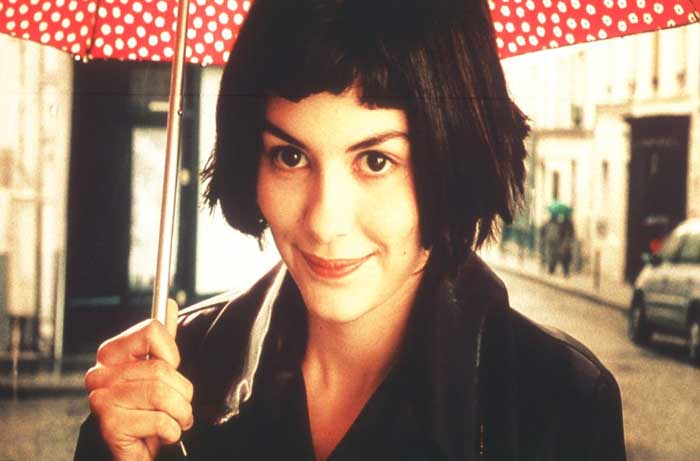
Le fabuleux destin d’Amélie Poulain


After much deliberation I have finally decided to write my first review. I’m always cautious about reviewing because I’m a very biased reviewer, as in I only like reviewing the things I like. Also, I don’t like reviewing the things I don’t like because someone has worked very hard to make a film or write a book and I feel guilty making flippant remarks about someone else’s hard work (unless it’s Dan Brown, of course. I mean, his name is DAN, why would people even consider reading something written by a man whose parents weren’t imaginative enough to give him a name that is no longer than three letters?)

But as usual I digress, the subject of this review is going to be the movie Amélie or Le Fabuleux Destin d’Amélie Poulain, as it is called in French. Don’t worry, there are not going to be any spoilers in this post, just some silly gushing that might give some of you an insight into female sentimentality. The movie is made in such a way that you either dislike it because you think that it is plot-less and well, a waste of time or you love it. I, unlike my unsentimental father, fall into this latter category.

I’m not sure what is it about this movie that makes it so different from all the other movies that I’ve ever seen; maybe it is the way in which the movie is filmed, maybe it is the soundtrack of the movie or maybe it is Amélie herself that I can identify with because she reminds me so much of myself. The first thing I wanted to do when I finished watching the movie the first time was re-start and watch it all over again

I’m not very sure how one could possibly label Amélie into a particular genre. I’m not sure whether it would be appropriate to call it a comedy. It doesn’t make you laugh out loud, just subtly smile and maybe even have a good cry. This tale of an innocent, lonely, naïve girl living in Paris charms everyone’s hearts. At the end of the movie, you can’t help but fall completely in love with this delightful character.

The movie has a brilliant cast. Audrey Tautou as Amélie is wonderful and I cant think of any other actress who could have played a convincing Amélie. The only danger for roles like these is that it might make an actor typecast for a certain set of roles. Also, just after seeing Amélie, I also watched Un Long Dimanche de Fiançailles (A Very Long Engagement) which is also directed by Jean Pierre Jeunet and stars Audrey Tautou in a very Amélie-like character. Even though that movie was great, I was kind of let down because of Tautou’s stereotypical character. Of course, I then watched The Da Vinci Code, which TPF has written about in a fabulous review that describes all my sentiments for that movie. Mathieu Kassovitz, on the other hand, is absolutely adorable. I am completely in love with him. I remember squealing and gripping TPF’s hand hard in the cinema hall when I realized that he was in Munich.

The movie has a wonderful soundtrack by Yann Tiersen. I’ve never loved the whole soundtrack of a particular movie before. But every track in Amélie is heart warming and it is impossible for a person to be indifferent the music in this movie because music plays such a pivotal role in this film. You just have to feel something when you listen to it, and I’m not saying this because I’m an angsting alternative-music listening teenager, but because I really do mean it.

Another strange thing is that though I’ve seen Amélie several times now, I’ve always seen it in Italian. Since Italian is not my first language, I don’t focus much on a movie when I’m watching it in Italian, but end up just keep trying to figure out the plot. It is rather rare for me to actually feel any emotion to what is happening on screen because I’m so caught up in the plot. Also, since it was a French movie translated into Italian rather than an English movie translated into Italian, it was much harder for me to understand it, at least the first time I watched it. I wonder how the English translation is. I am rather curious. I shall watch it in English eventually if I manage to find someone who owns the DVD in English.

Having said all this I have to admit that this is not a movie for plot oriented people, but for people who like focusing on the cinematography and the actual filming of movies. It is also meant for sentimental teenage girls who are looking for the smallest possible excuse to shed copious tears.

As a side note, I have a humongous Amélie poster in my room bought by TPF from Istanbul.

Friday, March 03, 2006

What immortal hand or eye/ Dare frame thy fearful symmetry?

I wrote this post ages ago but I wasn't sure whether it was appropriate for me to post it on a blog. I came across it in my files a few days ago and thought, why not. Anyways, I'm not sure what this post is going to turn out to be but I am not trying to offend anyone through it.

I read His Dark Materials by Philip Pullman three years ago and was overwhelmed by it. I was about 15 at that time and I don't think I understood all of Pullman's implications in the book and the symbolism very well. To tell you the embarrassing truth, I saw it like a normal, fantasy series like the Lord of the Rings (which is still one of my favorites) or anything else in particular. But then last year I was first introduced to The Songs of Innocence and Experience by William Blake and then later on Paradise Lost by John Milton because we were studying both the books for school. Suddenly, it all started making sense to me. I started understanding the full extent of Pullman's implications and was blown away by series itself. It quite strange actually people actually label this series under Children's Literature because I really don't think its meant for children and wouldn't recommend anyone to give it to their children.

Sometimes, as TPF said in one of her previous posts, literature has the habit just makes you feel strange and give you a certain desire, but at the same time an inability to continue reading. When you read a certain line or a specific paragraph in a good book, it affects you in such a way that you start feeling queasy and almost lightheaded. I think, I had that feeling all through The Amber Spyglass and it just made such an huge impact on my mind because it is such an intense book. It is basically a recreation of the famous 'Fall of Man' with different symbolic characters and a twist in the tale. I also get the similar feeling when I read certain poems by Blake or certain parts of Paradise Lost. My very favourite lines in Paradise Lost are the lines from where Philip Pullman got the title for His Dark Materials:


Into this wild abyss,
The womb of nature and perhaps her grave,
Of neither sea, nor shore, nor air, nor fire,
But all these in their pregnant causes mixed
Confusedly, and which thus must ever fight,
Unless the almighty maker them ordain
His dark materials to create more worlds,
Into this wild abyss the wary fiend
Stood on the brink of hell and looked a while,
Pondering his voyage,


I do understand that most people will find it hard to understand what is going on but I beg you to re-read them several times until you start getting the hang of what they mean. The key to understanding Milton is re-reading and trying to understand it in small bits, rather than the paragraph as a whole. After all, its only in English. Oh, by the way, the 'the wary fiend' that Milton talks about is Satan (if you hadn't already understood that), who is standing at the edge of hell looking into the land of Chaos that he has to pass before reaching Earth in order to tempt Man. Its rather interesting that Milton has aptly named the mansion in hell that Satan and his followers build for their meetings 'Pandemonium'. Its oddly fitting isn't it? What I love about Milton that he's explored a very different side of the famous story that almost everyone, Christian or non-Christian knows - 'the Fall of Man'. Don't get me wrong; he hasn't changed or misrepresented any facts. The story is an almost similar replica to the one told to us in the Old Testament, but with different implications. How can I explain it without being confusing? Paradise Lost is narrated from a different point of view, with Satan being the anti-hero of this epic poem.


'With Ambitious Aim against The Throne and monarchy of God
Rais'd Impious War in Heav'n, and Battel Proud'


The above quote is another one of my favourites. In Paradise Lost, Satan is the main character and God, one the other hand is seen as daunting and intimidating ruler, like in the Old Testament really. I mean, most of Book III in Paradise Lost actually describes a Lord Of The Rings kind of battle scene between Satan's army and God's army in heaven with weapons and the works. Of course, as we all know that God's side wins.

I love William Blake just as much actually. I can't believe that he actually wrote poems about his fascination with Hell and got away with nobody killing him:


'As I was walking among the Fires of Hell,
Delighted with the Enjoyments of Genius'


Blake was a poet much ahead of his times. He clearly believed himself to be the living embodiment of the spirit of Milton. Some of his poems in The Songs of Experience can be linked to the 'Fall of Man' and its future consequences as they are presented in the Old Testament and in Paradise Lost. The poems in The Songs of Experience may not seem linguistically complex for us to comprehend. This is because Blake's simplicity in language contradicts the complexity of his ideas. Most of his poems can be interpreted at different levels from a one-dimensional stories to multi-dimensional messages and we eventually realize that the seemingly simple content of his poetry is much more sophisticated than what it initially appears. One of my favourite Blake poems is A Poison Tree because it can just be understood at so many different levels:


A Poison Tree
I was angry with my friend:
I told my wrath, my wrath did end.
I was angry with my foe:
I told it not, my wrath did grow.
And I watered it in fears,
Night and morning with my tears;
And I sunnéd it with smiles,
And with soft deceitful wiles.
And it grew both day and night,
Till it bore an apple bright,
And my foe beheld it shine,
And he knew that it was mine,
And into my garden stole,
When the night had veiled the pole.
In the morning, glad I see
My foe outstretched beneath the tree.


William Blake also happens to the only man according to me who could have summed up in an unbiased way the entire 'The Fall of Man' in just 4 lines:


The sexes sprung from shame and pride,
Blowed in the morn, in evening died;
But mercy changed death into sleep;
The sexes rose to work and weep.


I do adore his poetry so much. Of course, I cannot end this post without mention his most famous poem, The Tiger, from where the title of the post comes from. It is a wonderful piece of work with implications that one would find almost inconceivable especially at the time when it was written.

I obviously not being a scholar or an expert cannot be arrogant enough to claim to understand even half of Milton or Blake's ideas, but whatever little I have understood from their work, I can say that I love them very much.

PS: This is long, I'm sorry. I do get rather verbose when I'm feeling particularly fangirlish.

Monday, January 30, 2006

Greek Tragedies, Real Life and All that Jazz

First off, I think I should start off with an apology. This is unfortunately going to be a serious post. Yes, I do realize that serious posts are rather boring but I beg you to bear with me and even skip this entry if necessary, in order to conserve your sanity.

That brings me to the point of this post. I've been writing an essay for English Literature which focuses on the theme of justice in the first part of the The Oresteian Trilogy by Aeschylus (btw, how does one pronounce Aeschylus?) and its got me thinking (which is something quite rare, so you can image how much of a big impact this must have made on me!). From the play Agamemnon, it can be seen that there is a lot of prominence is placed on the difference between the duty of a person towards his home and towards his city in Greek society. Agamemnon is in a conflict between his duty towards his home and that towards his city when he is given a choice between his daughter and participation in the war. The climax of the play occurs when Clytemnestra (Agamemnon's wife) kills Agamemnon, acting in accordance with the laws of justice. She claims that Agamemnon’s murder is an act of justice but alternatively she also does it for revenge beacause of the murder of her daughter. So basically, to put it simply, revenge is justice in Ancient Greek society and this idea creates a lot fundamental problems, as can be seen in The Eumenides, which is the third part of The Oresteian Trilogy.

Now what I find really surprising is that issues such as the conflict between need for taking personal revenge and the public system of justice that Aeschylus wrote about in 512 BC in The Eumenides that Athena eventually establishes are all pretty pertinent to our society in the 21st century. This whole concept of why you just cant just randomly kill someone who has killed someone close to you, but instead the murderer goes on trial in front of a jury and has a chance to defend himself is what every judicial system in the world is based on. Now this really shows the level of human development from 512 BC. When we look at society then and the society now, really what has changed? Well, obviously, you can say that there has been a lot of technological and teleological developments in the world but the crux of the matter is that the emotional problems or the dilemmas that humans faced more than 2000 years ago still remain the same. It seems to me from the above argument that there has actually not been any emotional development in man as time has passed.

Again, I'm not looking for any comments to this post, it was just a random thought that was going on in my head as I was doing my English essay, although if someone does have anything constructive to say, either to agree or to disagree with my opinions, I would be delighted to read them and I do promise something lighter for my next post, definately nothing on Greek Tragedies this time.